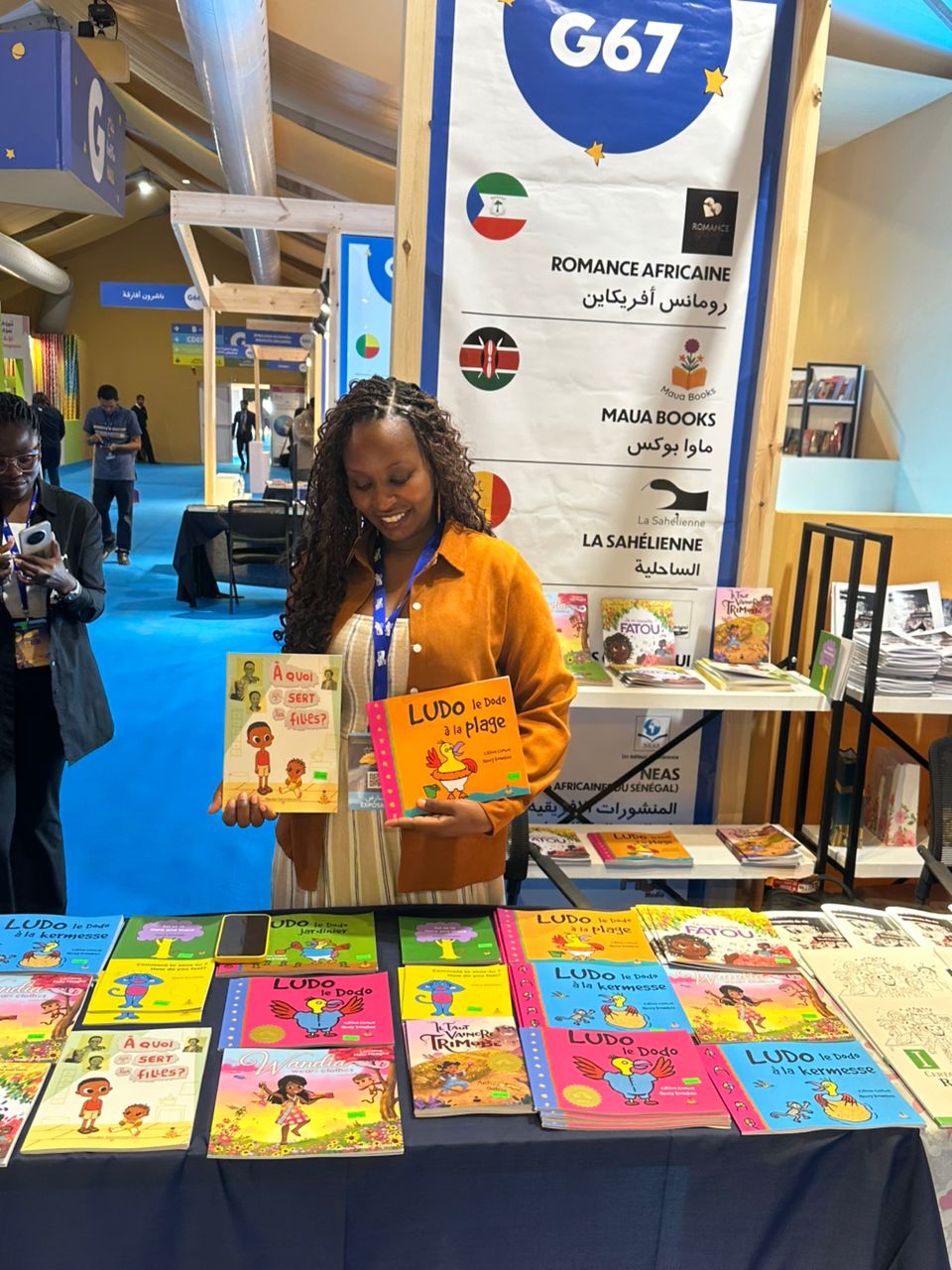
In October 2025, Maua Books took part in the Children’s and Youth International Book Fair in Casablanca, an international gathering that brought together publishers from across Africa alongside participants from Europe and the United States for 10 days. Representing the region at the fair, the team not only showcased African children’s books to new audiences but also joined critical conversations about sustainability, innovation, and the future of reading on the continent.
In this Q&A, Catherine Kukunda, Programs Manager Rwanda, reflects on the experience: from navigating a ten-day, sales-driven book fair to the shared realities facing African publishers, and the emerging opportunities shaping children’s publishing in East Africa.
You recently travelled to Morocco for an international book fair. Can you tell us about the event and how the opportunity came about?
The event was the Children’s and Youth International Book Fair, an international fair held annually in Casablanca. This was its third edition, organised by the Moroccan Ministry of Youth and Culture. Publishers from across Africa were invited to participate. We received the invitation in September for a fair that typically takes place in November, and Agnes played a key role in appointing and informing us about the opportunity. While Kenya was the official invitee, I was selected to represent Maua Books because it operates both in Kenya and Rwanda.
How long did the book fair run, and what was it like managing a stand throughout the event?
The fair ran for 10 days, from the 8th to the 16th October. It was intense because we had to be at our stand from 9 a.m. until 7 p.m. every day, which left very little time to move around or explore beyond the fair itself.
What was your experience like arriving in Casablanca and attending the book fair for the first time?
It was an international children’s book fair, first and foremost. Publishers and organisations from different countries came together to display, sell, and promote their work. My first impression was how thoughtfully organised it was. The fair was incredibly child-centred, with dedicated play areas, storytelling rooms, and interactive spaces designed specifically for young readers. One of the highlights was a fully animated room based on a selected story for that edition, allowing children to experience the book beyond the page.
How many African countries were represented?
The fair was truly international. Around 12 African countries were represented by publishers, alongside participants from Europe and the United States. Among the African participants, the focus was almost entirely on children’s publishing.
From the sessions and conversations you attended, what were your biggest takeaways about the state of publishing in Africa?
One of the most consistent themes was distribution. Buying and selling books remains a major challenge for African publishers. Many operate with little institutional or government support, which affects everything from printing to sales. Local printing is often expensive and inconsistent in quality, while printing abroad, though better in quality, drives costs even higher. These challenges ultimately make books less affordable and limit access for readers.
Many of these challenges are familiar across the continent. Did the discussions move beyond problems to possible solutions?
Yes, there were some practical approaches shared. One distributor spoke about planning annual sales targets and printing in bulk abroad to reduce unit costs. Distribution for them goes beyond bookshops; they place books in hotels, supermarkets, events, and other non-traditional spaces. Another publisher highlighted the importance of working closely with schools, organising Authors’ Days, and building long-term institutional relationships. These strategies may not solve everything, but they show that innovation and collaboration can make a real difference.
What opportunities do you see in Rwanda for children’s publishing and reading culture?
Rwanda is a very promising space for children’s publishing. As a parent, I’ve noticed a shift. This generation of parents is more intentional about nurturing a reading culture. Small reading spaces and children’s bookshops are emerging, often combining books with games and creative activities. Schools, especially private ones, are also creating reading clubs and family-focused literacy activities. While government institutions remain challenging due to limited purchasing power, the private sector offers real opportunities for growth and partnerships.
Were you able to sell books during the fair, and how would you assess the commercial outcome of participating?
Yes, the fair was largely sales-driven, and we made steady sales over the 10 days. In fact, we performed strongly compared to many of the other African publishers present. Since participation and travel costs were covered, the experience was commercially worthwhile. In addition, the Moroccan National Library took samples of our books for review, opening up the possibility of a future institutional procurement.
Did the fair open up any opportunities for partnerships or acquisitions?
We went in open to identifying potential titles for acquisition, but none of the books on display aligned strongly with our publishing vision. One Moroccan publisher working in adult publishing did visit our stand and shared that they faced similar challenges, including limited government support and financial strain, despite Morocco’s stronger publishing reputation.
What did you observe about children’s reading preferences during the fair?
Children were clearly drawn to visually engaging books. Our covers stood out because they were colourful and immediately appealing. I also noticed strong interest in comic books, even though many of the comics available lacked depth in reading value. It highlighted an important gap between what attracts children visually and the quality of content being produced.
Looking back, what did this experience in Casablanca reaffirm about children’s publishing in Africa?
It reaffirmed that the challenges we face are shared across the continent, but it also showed that there is strong demand, creativity, and opportunity. With better distribution strategies, stronger partnerships, and continued investment in quality content, children’s publishing in Africa has significant room to grow.